


Today we commemorate the Baptism of our Lord Jesus Christ. Baptism is a sacrament that cleanses us of original sin. We all know that Jesus Christ was free of original sin, and besides, he was utterly sinless. If that be the case, why then did he wish to be baptized? There are several reasons why Jesus wished to receive Baptism.
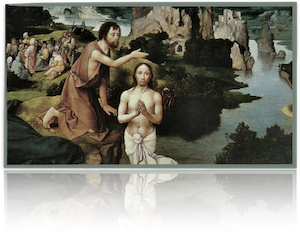
In the Gospel of Matthew, when Jesus approached John the Baptist and asked him for Baptism, John was greatly surprised. He said, “I am the one who should come to you for Baptism. Why then are you coming to me?” Jesus replied, “This is the way God the Father has arranged it, and so let us follow His will as best as we can.” Also, Jesus accepted Baptism because He wished to identify Himself with all sinners. He was as though tacitly informing the people, “Listen, all of you, I am accepting Baptism because I, too, am a human being like you.” The Baptism of Jesus was an occasion for all three persons of the Blessed Trinity to be clearly revealed. When Jesus, who was God the Son, received Baptism, the third person of the Holy Trinity, namely the Holy Spirit, appeared above him in the form of a dove, and the voice of God the Father was heard saying, “This is my Beloved Son in whom I am well pleased.” That is to say, the Father, Son, and Holy Spirit were all revealed together.
We have three types of Baptisms, namely the Baptism of Water, the Baptism of Desire, and the Baptism of Blood. The Baptism of water is the type of Baptism John administered to Jesus, and it is the same Baptism all of us have received. We are Catholics today because of the Baptism of water that we have all received. The Baptism of Desire is accepted by Catholics, Anglicans, and Lutherans. Here, all who lead kind and virtuous lives, but were not baptized, will nevertheless receive the salvation of God when they die. When Pope Francis visited the USA, he said that all who did good works, even if they be Atheists, will be saved. When the Pope made that assertion, he was only reiterating what was already stated in the Second Vatican Council, namely that truth is found in non-Christian religions as well. That is to say, the Spirit of God works in other religions as well.
When we study the life of Jesus, we notice that initially he was busy mainly with the Jews, but later his vision steadily widened and came to embrace the entire world as well. In Matthew chapter 15, Jesus was deeply touched by the Canaanite woman, who entreated him to heal her daughter. When Jesus said to her, “It is not right to take the bread of the children and toss it to the dogs,” the woman retorted, “even dogs eat crumbs that fall from the master’s table,” and in Matthew 8, he was moved by the Roman centurion, who besought him to heal his servant. The Roman centurion did not want Jesus to enter his house, because he was aware that Jews were not allowed to enter houses of non-Jews. Here, what perhaps impressed Jesus was the humility of the man and his concern for his servant. We have every reason to believe that both the Canaanite woman and the Roman centurion received the Baptism of desire and that they are currently in the presence of God. That is to say, all mankind is to be united into one great community of love.
The Baptism of Blood is granted to any unbaptized individual who dies for the sake of God and His Church. During the early centuries of the Christian era, numerous wars were fought in various parts of the world, and many who desired Baptism and were preparing to receive Baptism of water, were slain before they could be baptized. Such people receive the Baptism of blood. Since they died like martyrs, they are entitled to enter like martyrs into the presence of God.
By Fr. Cyril Veliath, SJ